Payment processing services that empower
your business today and tomorrow
Your merchants can start integrated payment processing—and you can start monetizing payments—quickly and easily with WePay.

Tailored solutions for your needs
We build lifelong relationships that scale over time and support you throughout our partnership.

End-to-end financial services
Access a complete suite of payment solutions with the scale of a bank and the efficiency of a SaaS provider.

Innovation and agility
Make the most of our best-in-class integrated payment solutions and easy-to-integrate APIs.

Revenue expansion
Maximize revenue opportunities for your business by monetizing payments the right way.
Partner with the payments leader
#1
Nilson Report, March 2022 and JPMC Annual Report, April 2022
31.8B
Nilson Report, March 2022 and JPMC Annual Report, April 2022
50%
Nilson Report, March 2022
$100M+
Nilson Report, March 2022 and JPMC Annual Report, April 2022
Powerful integrated payments for any business model
From referral partners to full-blown payment facilitators, we’ve got you covered. All with instant onboarding, same-day deposits, transparent pricing and flexible card acceptance. And humans to help when you need them.
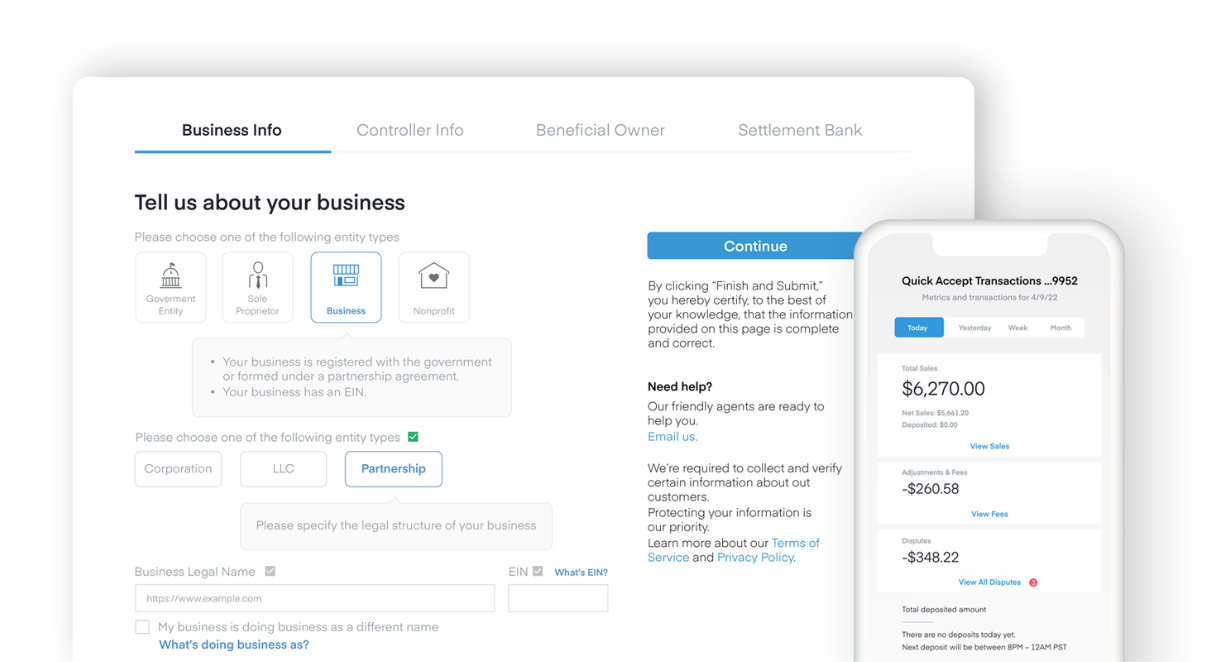
![green-check.svg]() Instantly onboard merchants
Instantly onboard merchants
 Instantly onboard merchants
We handle the KYC process so your merchants can onboard quickly and start accepting payments.
![green-check.svg]() Do more with digital servicing
Do more with digital servicing
Merchants can manage onboarding, transactions, reporting, chargebacks, user access and more with our complete Merchant Center.
![green-check.svg]() Grow your payments with ease
Grow your payments with ease
Our Partner Center has powerful capabilities offering sophisticated reporting, analytics, support and customization.
![green-check.svg]() Build without the overhead
Build without the overhead
Have peace of mind knowing WePay takes on risk and PCI compliance and covers fraud and chargeback loss.
Terms apply; risk types include: fraud, credit, compliance, AML, sanctions, and KYC
![green-check.svg]() Improve your cashflow
Improve your cashflow
Take advantage of our flexible payouts and same day deposits feature with no additional cost for you1.
Explore our solutions
Customize the payments experience

Clear
Create an end-to-end user experience without the overhead. We’ll manage risk, compliance and payouts, and keep you informed through our API.
LEARN MORE
Customize the payments experience
Clear
Create an end-to-end user experience without the overhead. We’ll manage risk, compliance and payouts, and keep you informed through our API.
LEARN MOREProcess payments quickly
and easily

Link
Enable merchants to open an account instantly and accept payments immediately, allowing their customers to checkout directly on your platform.
LEARN MORE.svg?auto=webp)
Become a payment facilitator

Core
Support an array of payment methods and use cases, and enable fast and flexible payouts while offsetting processing fees by integrating with J.P. Morgan’s core infrastructure.
LEARN MORE